
How Machine Learning Works in Real Life
Machine learning is a branch of artificial intelligence that learns from data, identifies patterns, and continuously improves its predictions without being explicitly programmed for every task.
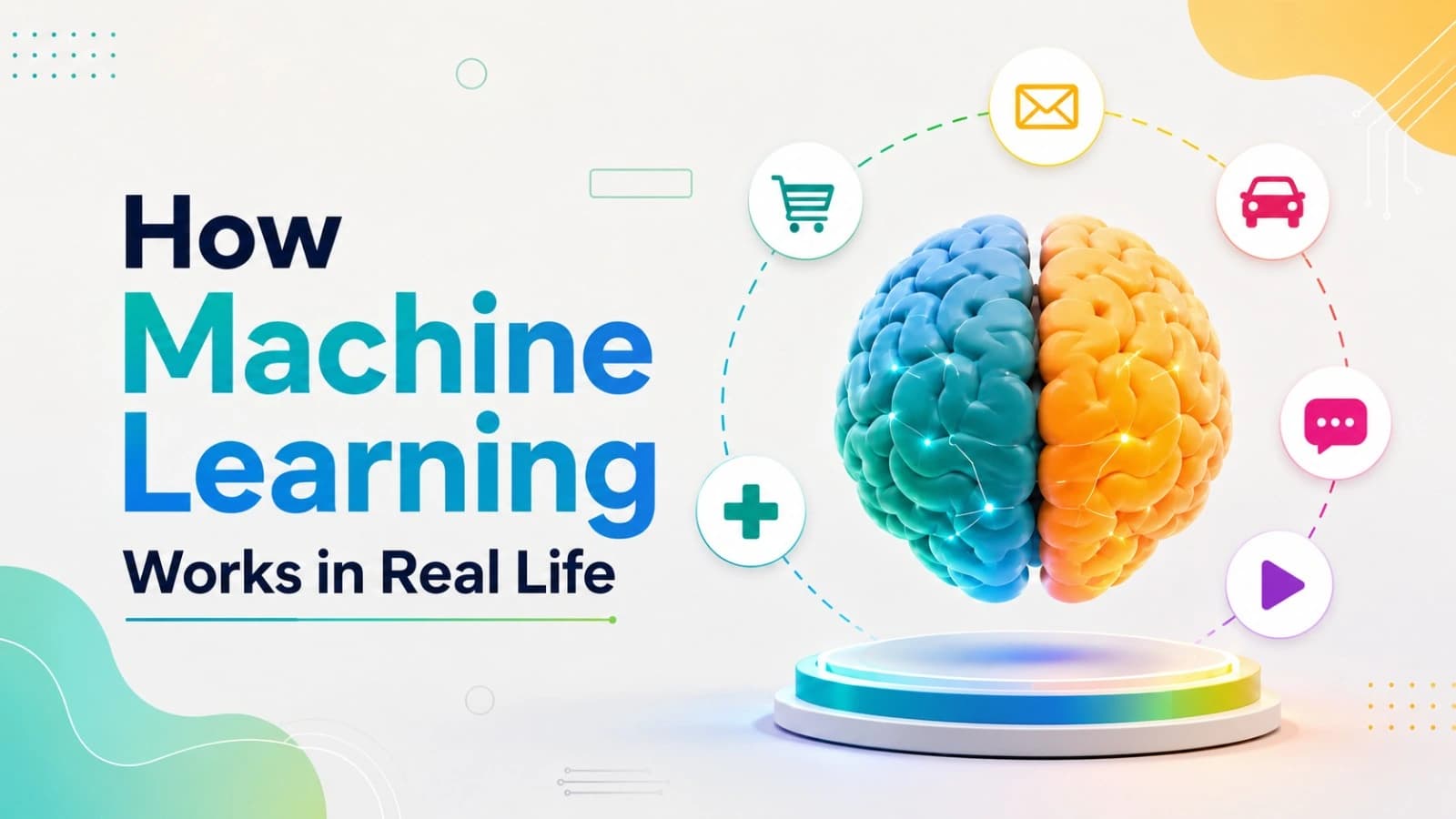
Machine Learning is one of the key players in today's world, despite the fact that a lot of people hardly even realize when it works for them. Machine learning is responsible for suggesting movies we should watch or songs we may like and for finding the fastest route with navigation services. At the same time, despite all the significance of the technology, it often remains unclear for a lot of people. The thing is that machine learning is not something magical nor a human-like computer that can think by itself. It is rather a technology that allows machines to learn based on the information they get, find patterns and improve their results without being programmed for that specifically.
What Is Machine Learning, Really?
Before we dive into seeing how machine learning works, it would be better if you had an idea of what it really is. Machine learning is a field of artificial intelligence that allows computers to learn from data and improve their performance over time instead of relying on detailed instructions for every individual task. What happens here is that rather than developing hard and fast rules in each case, a lot of data is provided to the system, and it makes patterns out of them on its own. Then, these patterns enable the system to perform actions in new and unseen scenarios.
Unlike traditional programming, where developers create detailed instructions for every possible situation, machine learning enables computers to learn by analyzing examples. As the system processes more data, it identifies patterns, builds its own predictive model, and continuously improves its accuracy over time.
A Brief Look at How Machine Learning Developed
Nevertheless, machine learning was more of a theory than practice for quite a while since computers did not have the sufficient capacity nor sufficient access to the vast amounts of data required. Machine learning only became an actual technology with tangible applications following increases in computing capabilities and availability of big data through the internet. Currently, machine learning systems form part of many applications used every day by people, even when they do not know it.
How Machine Learning Actually Works: The Step-by-Step Process
Although there are many applications for machine learning, the basic procedure is normally the same in all cases:
Data Collection: Collection of pictures, text, numbers, buying history, or any other data that is needed for solving the problem.
Training the Model: Input of data into the model, which will then try to find some patterns and connections, constantly updating itself.
Testing and Evaluation: Testing the model on new data in order to check its performance in real conditions, not on the trained data.
Deployment and Improvement: Putting the model into practice, when it starts learning on new data and constantly gets better at what it does.
The collection and training process results in the development and testing process of a system that then becomes more dependable the more often it is employed.
Real-Life Examples of Machine Learning in Action
The application of machine learning is not something reserved for theoretical purposes only, rather it is a part of our lives in many different ways. For instance, online streaming sites like Netflix and Spotify apply machine learning algorithms to track viewing and listening patterns and make relevant recommendations accordingly. E-commerce websites make suggestions of products to buy according to the user's browsing and purchasing history along with the behaviors of other consumers who act similarly. Email services use machine learning algorithms to identify and block all the spam emails based on the characteristics of such messages. Siri and Google Assistant are able to comprehend speech and reply correctly due to machine learning algorithms. Bank applications use this technique to detect any irregularities in transactions that might be associated with fraud activities. Furthermore, navigation applications, such as Google Maps, make predictions about traffic and provide the quickest way to get to a desired place.
All of these examples prove that machine learning is already a part of our daily life.
Key Traits That Make Machine Learning Powerful
There are several key factors that have led to the widespread adoption of machine learning technology within many industries:
It is continuously improved as more data is made available, without any need for continuous reprogramming.
It can recognize complicated patterns within the data that will be impossible for human beings to detect on their own.
It can easily scale to handle massive amounts of data, processing information far more quickly and efficiently than a person could manage manually.
It has the capability to adapt to new environments over time; hence it is ideal for situations that evolve over time like customer behavior patterns.
Types of Machine Learning Used in Real-World Applications
For better comprehension of how machine learning functions in reality, it is important to acknowledge that there are several approaches that this field is traditionally divided into. In other words, the right answer is already known before training takes place, and the task can be related to spam detection or price prediction. The second approach is called unsupervised learning, and here the system gets unlabeled data and should identify certain patterns on its own, and this can be helpful in such issues as customer segmentation and anomaly detection. The third approach is reinforcement learning, and here the system is being trained through rewards and penalties.
All these approaches are applicable to various real life tasks, and most of the modern machine learning examples apply more than one of these approaches at once.
Why Understanding Machine Learning Matters
Having knowledge about how machine learning functions does not serve developers and data scientists alone; rather, it is practical for ordinary people, businessmen, and decision makers too. Ordinary people need knowledge of machine learning to understand why certain recommendation engines, advertisements, or search results are appearing in a certain way. Businessmen who know the fundamentals of machine learning will have an insight into automation and decision-making opportunities using big data. And for students and professionals, having basic knowledge of machine learning gives them entry into one of the hottest areas of modern technology.
Challenges and Limitations of Machine Learning
Despite the advantages of machine learning, however, machine learning does have some inherent shortcomings. The accuracy of machine learning algorithms depends greatly on the data on which they are trained flawed, biased, or missing data means flawed predictions. Moreover, machine learning algorithms cannot handle completely new situations, as their functioning largely depends on recognizing patterns learned through previous experience. For this reason, thorough data preprocessing, as well as regular monitoring and updating of machine learning algorithms, are still crucial in practical applications of machine learning.
Machine Learning vs. Artificial Intelligence
Artificial Intelligence
AI refers to the broader discipline concerned with the development of systems that are able to carry out tasks that normally need human intelligence, like reasoning, natural language understanding, image recognition, decision making, etc. In other words, AI is the bigger picture, the overarching concept, in other words, the creation of intelligent machines. It can be done in many different ways, like pre programming the system to do things in accordance with certain instructions provided by humans, regardless of any kind of adaptation or learning on the system’s side.
Machine Learning
Machine Learning can be described as a particular branch of AI, it is one of the ways by which artificial intelligence can be reached. As opposed to those systems that follow some kind of fixed instructions, machine learning systems imply learning from experience and getting better over time without any explicit programming. The latter implies that the machine learning system finds out the pattern in data by itself and then applies it further. Recommendation systems, voice recognition software, and even fraud detection are some examples of this type of technology. Simply put, everything related to machine learning is a part of AI, while AI itself may not always use machine learning, the latter is just one of the tools to get AI.
Conclusion
It might seem like machine learning is something complicated and difficult to understand; however, in essence, the process is quite logical and simple. One needs to collect data, train a machine, test its effectiveness and make continuous improvements. From movie recommendations in your online streaming services to fraud detections in your banking account, machine learning works behind the scenes. Learning about the process of machine learning and how it works in practice allows one to better understand the power of machine learning and its potential in transforming the reality we live in.
Share this article
Related Articles
Future of AI: Opportunities and Risks
This article explains the good and bad sides of AI's future in simple terms — what it can do for us, and what dangers we need to watch out for.
7 Examples of Artificial Intelligence Applications in Our Daily Lives
This article explains what AI is in easy words and shows 7 ways you already use it every day.
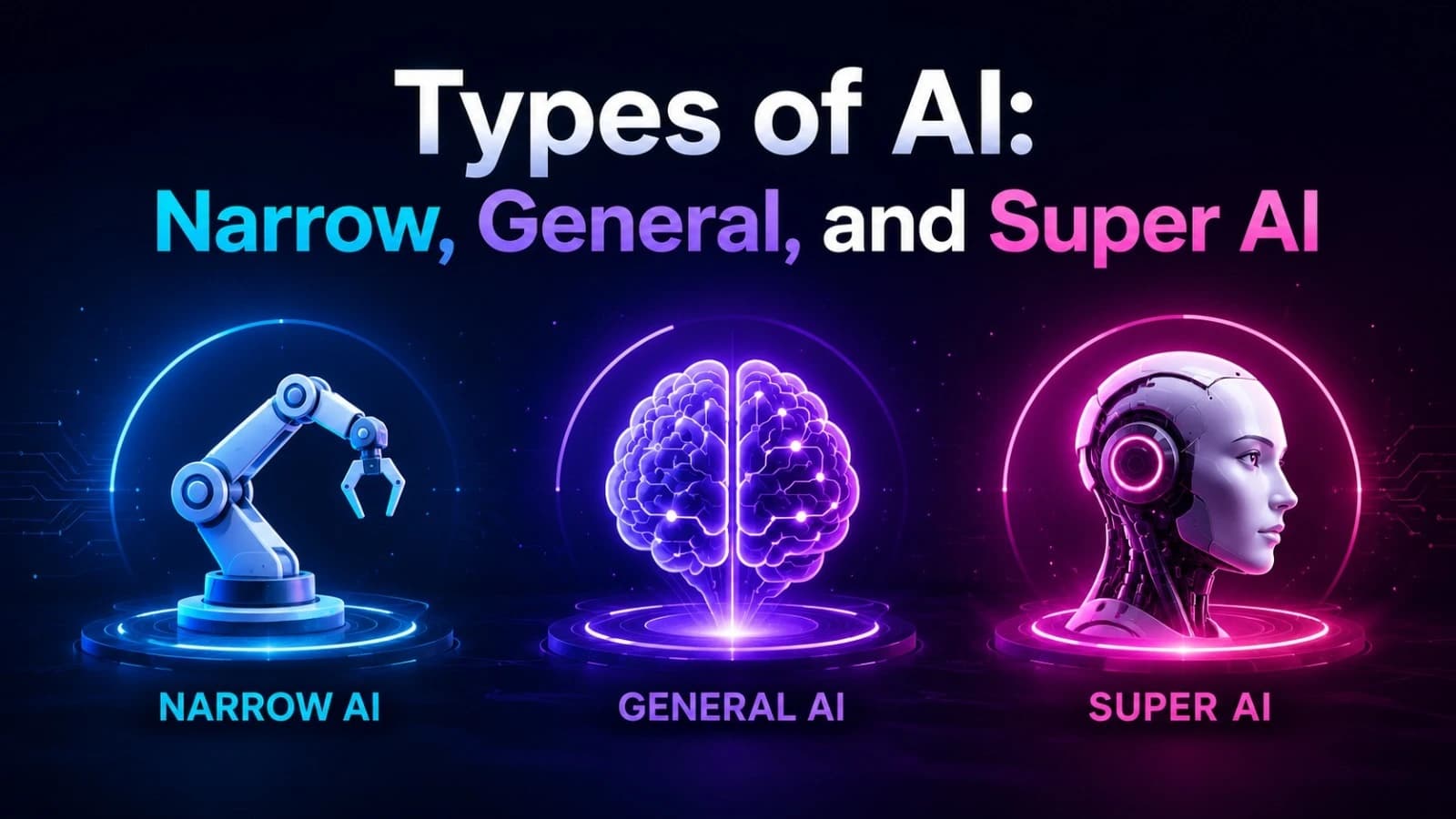
Types of AI: Narrow, General, and Super AI
Artificial intelligence is divided into three types: Narrow AI, which performs specific tasks; General AI, which aims to achieve human-level intelligence; and Super AI, a theoretical form that would surpass human intelligence.