
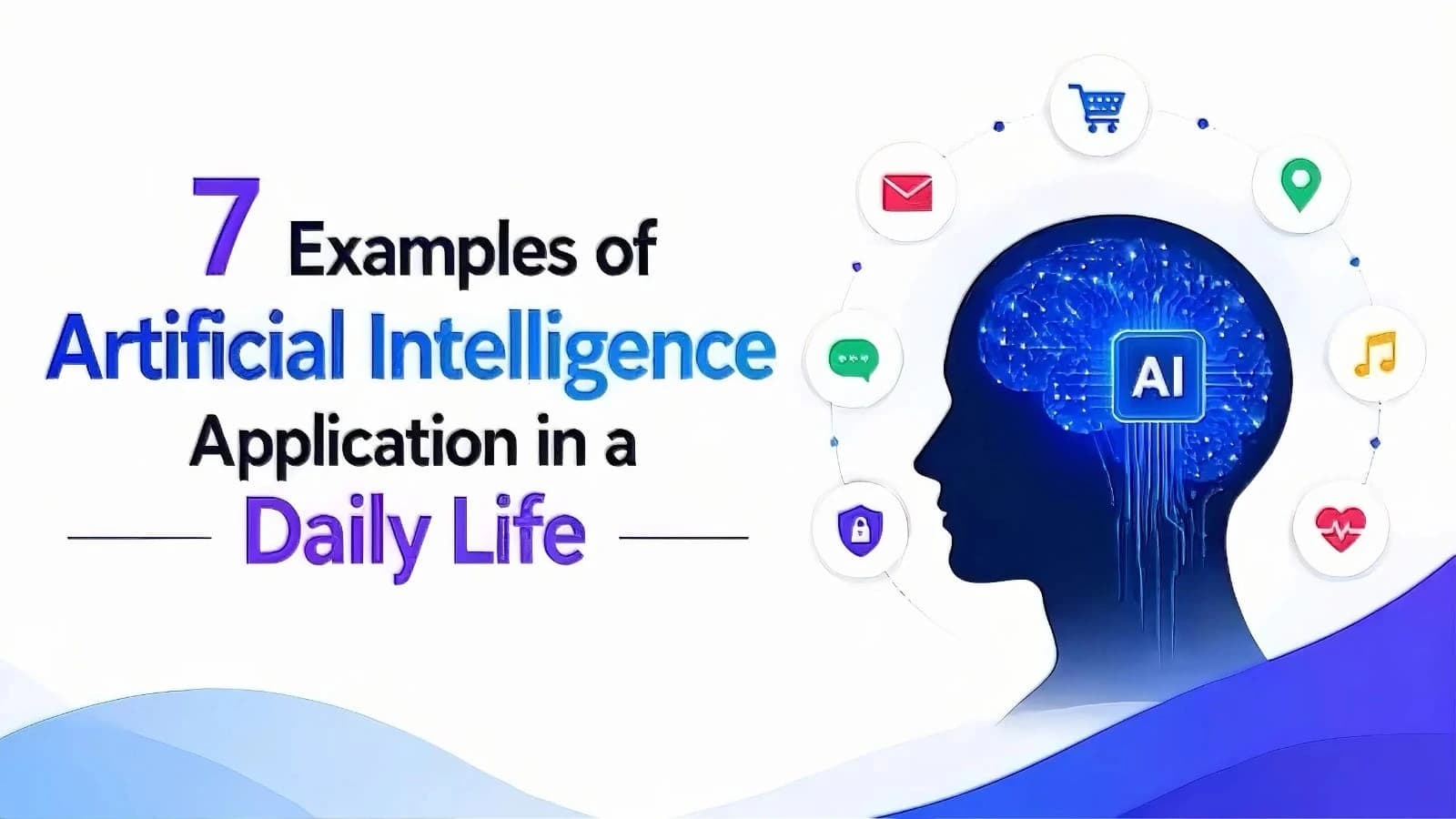
7 Examples of Artificial Intelligence Applications in Our Daily Lives
This article explains what AI is in easy words and shows 7 ways you already use it every day.
Introduction
Artificial intelligence silently powers many routine tasks, streamlining everything from your morning commute to entertainment and online security. These seven daily examples illustrate how machine learning algorithms and natural language processing shape modern convenience
It may seem that artificial intelligence has become one of the most discussed innovations of our times. But not everybody understands what this term means and how it functions. It may be associated with the image of a humanoid robot from some sci-fi movies, but it is much closer to your everyday routine. Every time you unlock your phone using your face, your spam emails are filtered out, or an online service suggests some new entertainment for you to watch, you deal with artificial intelligence without even noticing.
What Is Artificial Intelligence?

AI, which stands for artificial intelligence, is the name given to computer programs created to carry out activities requiring human intelligence. These include actions such as speech recognition, language comprehension, image pattern identification, prediction, and decision-making with minimal human involvement.
While conventional software works on a pre-defined rule ("if something happens, then this should be done"), AI applications work in a way that they can learn from data. With more and more data input, they will get smarter and smarter at recognizing the pattern. This kind of intelligence of AI applications is referred to as machine learning, which belongs to the field of AI.
Deep learning is a more advanced form of machine learning that involves using multi-layered neural networks, somewhat modeled on the human brain, that can deal with large quantities of data – from pictures to audio clips, from text to video recordings. This explains how an advanced AI system can quickly identify a person's face in a picture or write an answer to a question posed.
It might be useful to recognize the fact that all of the AI we currently have is narrow AI (sometimes referred to as weak AI). Narrow AI has been developed to perform one particular task for example, suggesting a certain product, detecting fraud or translating a sentence – exceptionally well. Such an artificial intelligence program can't develop thoughts on its own nor can it apply the knowledge gained in the process of performing this task to anything else. This concept should not be confused with the much more hypothetical notion of general artificial intelligence (AGI), which would equal humaThus, when dealing with an app driven by AI technology, you are not communicating with some sort of machine that can think for itself. Rather, you are working with a sophisticated tool designed to execute a particular task and one that does so with more efficiency and greater speed than is possible for human intelligence in virtually all aspects.
Thus, when dealing with an app driven by AI technology, you are not communicating with some sort of machine that can think for itself. Rather, you are working with a sophisticated tool designed to execute a particular task and one that does so with more efficiency and greater speed than is possible for a human.
Another helpful fact to know is that AI is not just one software program but an overarching term that refers to various interrelated areas of study. NLP enables the comprehension and production of human language by computers. Computer vision is the ability for a computer system to understand an image or video footage. Robotics involves applying artificial intelligence to control machines and work in the real world. Generative AI, which has been the fastest-growing area of research in recent years, involves generating new texts, images, sounds, or videos based on the learned patterns of data.
With this base covered, it is time to examine precisely how this technology manifests itself in your day-to-day life.
7 Examples of Artificial Intelligence

1. Voice Assistants
Some of the best-known examples of artificial intelligence in daily life include Siri, Alexa, and Google Assistant. Using technology such as speech recognition and natural language processing along with machine learning algorithms, these technologies are able to determine your request and respond accordingly.
What gives modern day voice assistants an edge is their contextual awareness. Not only are they able to respond to commands, but are also increasingly capable of responding to multiple command sequences, such as getting weather forecasts followed by clothing recommendations in one go.
2. Smart Navigation and Ride-Sharing Apps
When you receive recommendations for routes that take you away from a traffic jam via Google Maps or it finds you a better route than your usual one, that is when AI processes live traffic information, incidents, road closure reports, and even weather reports. It uses a large number of data points gathered from the experiences of other people on the road.
Like ride-hailing applications, AI is used in traffic control systems that connect travelers to nearby vehicles and calculate fare prices for the trip. Traffic management in many cities is made possible by artificial intelligence, which optimizes traffic lights and reduces unnecessary fuel consumption.
3. Personalized Recommendations
Have you ever noticed that Netflix knows precisely which program you'd like to watch next, or perhaps that Spotify creates a playlist that is perfectly suited to your liking? That's the power of a recommendation engine. It is an AI algorithm that looks into your history of interactions with certain content and makes recommendations based on it.
This same technology is behind online shopping recommendations. When the e-commerce website says that their product recommendation is based on "your browsing history," then in reality, they have used AI algorithms to predict what you would like to purchase.
4. Facial Recognition and Smartphone Features
The ability to unlock your phone just by looking at it is made possible through artificial intelligence-based facial recognition technology, where your facial features are mapped out and matched to the existing data on file within milliseconds. The same technology underlies other applications such as photo applications, where faces can be tagged, images sorted, and backgrounds blurred for portraits.
Apart from face unlock, the camera on your phone applies AI for automatic enhancement of photos according to its assessment of the conditions, such as poor lighting, low focus, and other factors, regardless of whether it is a sunset, food, or a crowd.
5. Spam Filters and Smart Email Tools
Your inbox is much cleaner because of AI. The email service uses machine learning algorithms that have been trained with huge amounts of data regarding spam and normal email. These filters automatically remove any emails that do not pass the test of being spam-free.
AI has gone further to composition after having developed from filtering. Several email services provide intelligent suggestions, autocomplete options, and even automatic responses based on the conversation tone and context.
6. Fraud Detection in Banking
Each time you use your credit/debit card or make an online transaction, there is a high probability that some sort of AI algorithm is doing the background work to check whether it is all legit. Machine learning is used by banks and other financial institutions to monitor spending behavior and detect any anomalies, such as a transaction abroad right after a local transaction.
Detecting frauds in this way is next to impossible for humans to achieve manually, whereas an AI system is capable of analyzing millions of transactions within seconds, and learning how to identify new patterns of frauds as they evolve.
7. Healthcare Diagnostics and Wearable Devices
AI is becoming a useful technology for healthcare as it helps in early detection of diseases and analysis of medical images at a speed beyond human capability. Models created through machine learning algorithms using big data in medical imagery will help to identify any abnormality in X-rays, MRIs, and other images.
As far as personal applications go, wearables such as smartwatches can use AI technology to track your heartbeat, sleeping patterns, and physical activity, providing personalized information and alerts that might be useful when consulting a physician. Some smart alarms are designed to wake you up in your light sleep phase, allowing you to wake up feeling well-rested.
Final Thoughts
AI technology is not something that belongs to some future era, but something that we use on a daily basis; We are using this technology in numerous ways during the course of each day. Starting from waking up with an intelligent alarm clock, through the directions for travel that are provided by our GPS, all the way to the content we are consuming.
Knowledge of AI and how it operates is not just essential for tech fans. The more this technology develops and becomes more popular in different spheres of activity, the more useful it will be to know its fundamental principles so that you can make the right decision regarding the software you are using.
AI will continue developing further, but the essence of its function will remain unchanged: to perform repetitive and data-intensive tasks to give people time, accuracy, and the ability to concentrate on what requires human intervention.
Frequently Asked Questions
Is artificial intelligence the same as robots? Hardly! Because robots are mechanical devices and artificial intelligence is the software or “brain” used to control them. Most AI applications do not have a physical form because they exist as purely software-based technologies.
Do I need technical skills to use AI? No. The everyday AI technology that you use is not something that you will code yourself. In fact, most AI programs you use in your everyday life work in the background without any need for programming at all.
Is AI the same thing as machine learning? The Machine learning technique is a branch of AI. The former is a technique used in order to make computers act intelligently. It is part of the larger concept of AI, which seeks to develop intelligent systems.
Is artificial intelligence safe to use? In line with the case of other technologies, the use of AI has its pros and cons. While reputable AI is designed with security and privacy in mind, it is always advisable to have knowledge of what type of information is collected by the application.
Share this article
Related Articles
Future of AI: Opportunities and Risks
This article explains the good and bad sides of AI's future in simple terms — what it can do for us, and what dangers we need to watch out for.
How Machine Learning Works in Real Life
Machine learning is a branch of artificial intelligence that learns from data, identifies patterns, and continuously improves its predictions without being explicitly programmed for every task.
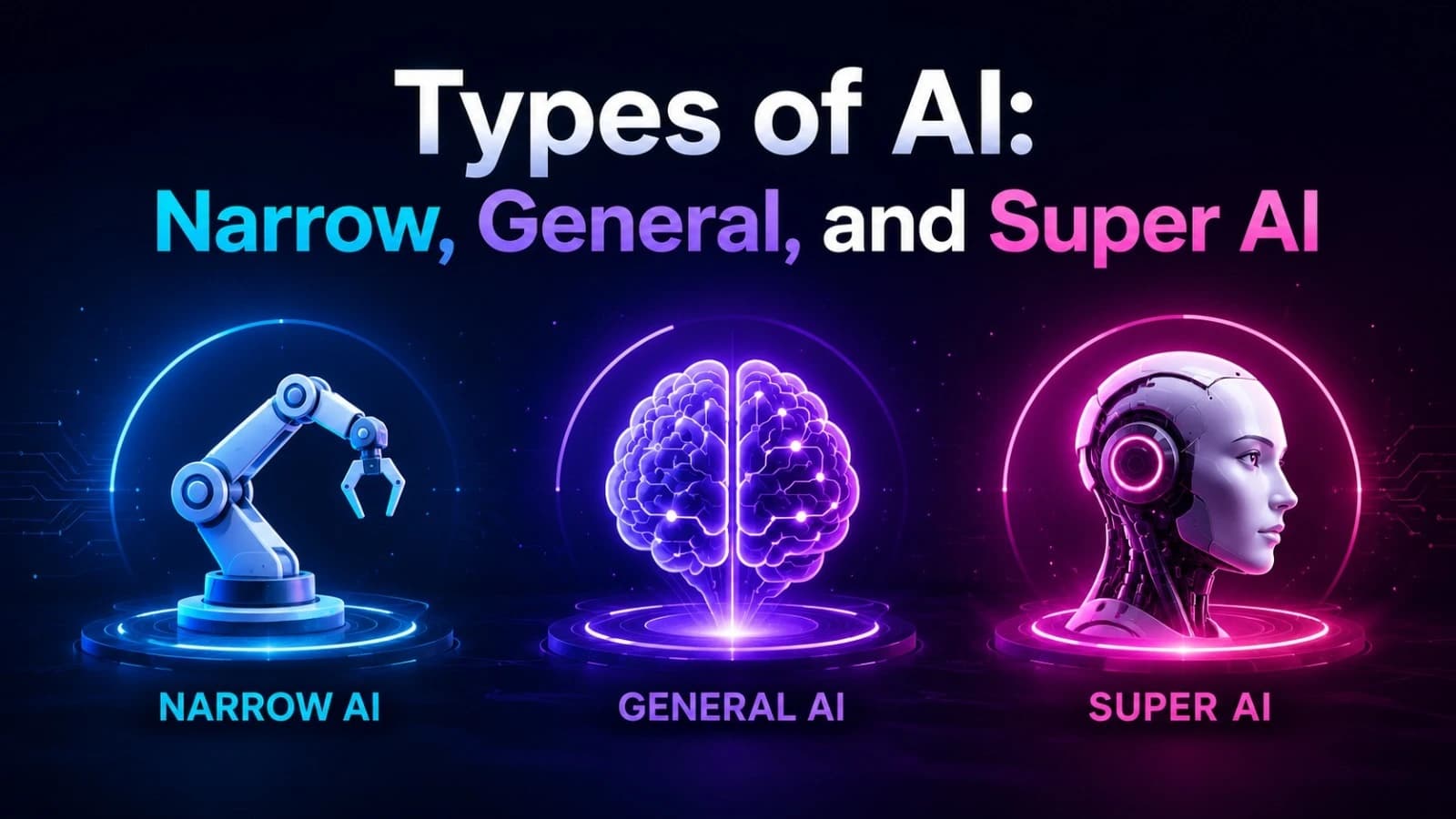
Types of AI: Narrow, General, and Super AI
Artificial intelligence is divided into three types: Narrow AI, which performs specific tasks; General AI, which aims to achieve human-level intelligence; and Super AI, a theoretical form that would surpass human intelligence.