What Is Cloud Gaming and How Does It Work?
Cloud gaming lets you play games streamed from powerful remote servers, so you don't need expensive gaming hardware.
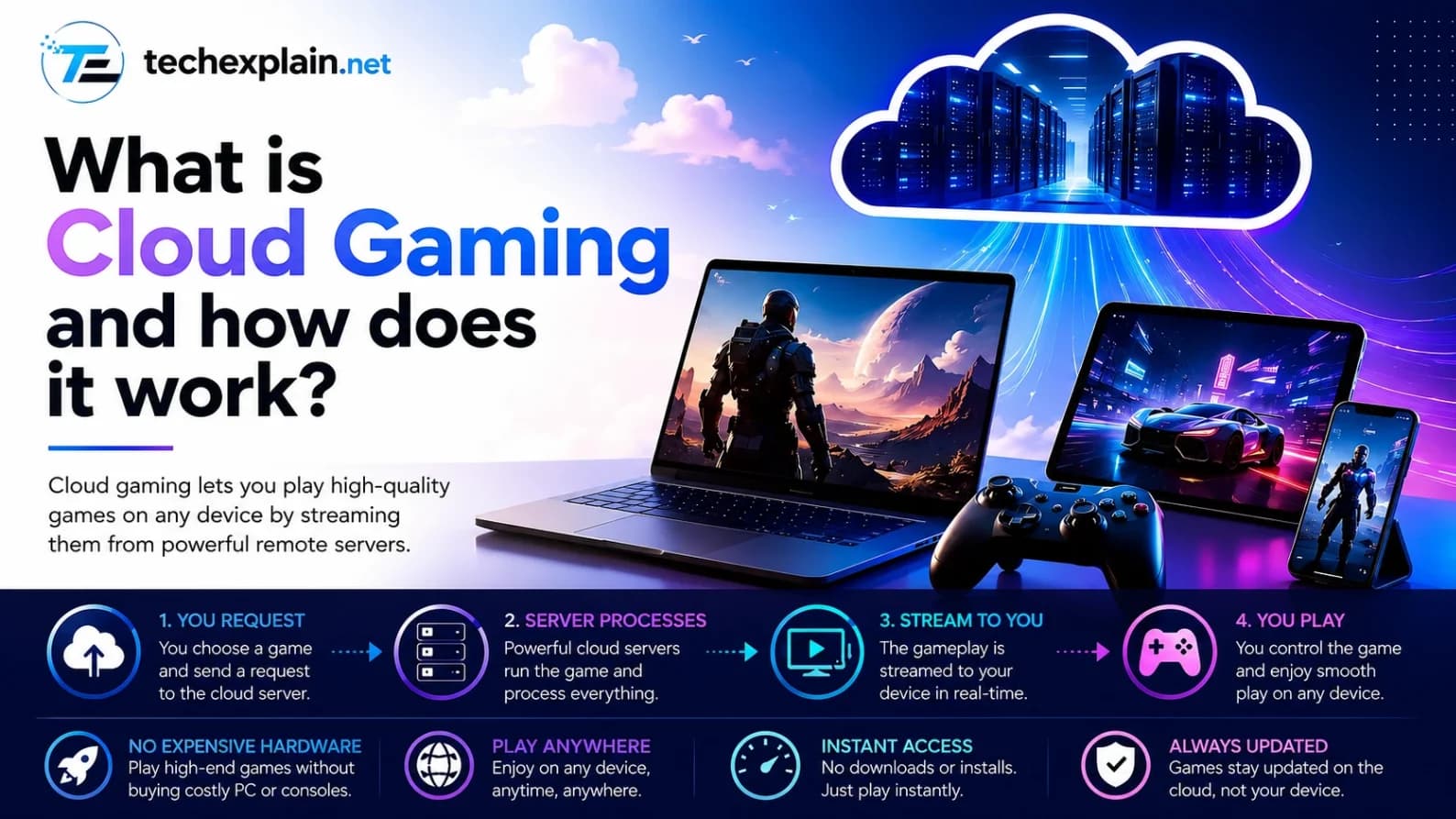
Cloud gaming lets you play video games by streaming them from powerful remote servers over the internet. Instead of running on your local phone, computer, or console, the game renders in a data center, sending you a live video feed while instantly reacting to your controller buttons.
But not that long ago, experiencing the latest challenging game meant getting yourself a game console or constructing a gaming PC with a high-end graphics card. This requirement is being quietly phased out. The phenomenon of cloud gaming has evolved from an obscure trial into an everyday method of playing, and current industry statistics place the global market anywhere between $6 and $28 billion by 2026, according to how each research firm defines cloud gaming, with the growth rates reaching up to 25-46% annually. In this guide, you'll learn about what exactly cloud gaming is, how it works, which platforms offer it, and what the pros and cons are for making a final decision.
What Is Cloud Gaming?

Cloud gaming, or alternatively referred to as game streaming, is a gaming technology whereby the game is executed remotely at a server inside the data center and not on the device being used. The phone, computer, or smart television is just responsible for showing the video stream of the game and sending back user inputs to the server. It is best understood by considering the way in which a streaming video is watched on the Internet – there is no need to first download the file before viewing; you just click play and you get the video content immediately. Cloud gaming takes this concept and extends it to interactive software, although it poses an additional problem in that the video has to respond to the users' commands immediately.
Since the computations actually take place somewhere else, what you have in your hands is virtually insignificant. It doesn’t matter whether it is an old computer from five years ago or just a cheap tablet since they will be able to show the same video game in the same way because the server is doing the computations.
How Does Cloud Gaming Work, Step by Step?
It seems like an instantaneous experience for the player, but there is a lot going on behind the curtain for each individual button press. To start off with, moving a joystick, pressing a key or tapping on a touchscreen translates to a small packet of data. This packet is transmitted via the internet directly to a remote data center where the game session runs on a special server. Your inputs are processed by the powerful GPU and CPU on the server just as the console or gaming computer processes them at home. Real-time transmission of a raw video stream is simply not practical, so the server encodes and compresses each frame in much the same way as a video call is encoded. This encoded and compressed video stream is then transmitted via the internet to your end device where your phone, laptop or television decodes and shows it. All of this happens usually within a couple dozen milliseconds after you initially interacted with the game. And this is what is happening repeatedly dozens of times every second to create a smooth gameplay experience. And the time it takes for this round trip of your actions to be reflected back in the game is called latency.
The Technology That Makes It Possible
Only after several related technologies reached maturity was cloud gaming possible enough to be enjoyable, rather than just a sluggish gimmick.
Data centers built for real-time rendering: The cloud technology that has been developed traditionally is designed to cater to processes such as storing information or carrying out batch processing, and in such cases, a lag time of one or two seconds goes unnoticed by the end user. This is not the case with games, which have no patience. The cloud companies today host racks of GPUs and CPUs customized to generate frames at near real-time speed.
Edge computing: Instead of sending data from all players to one mega data center, companies have been creating edge nodes, which are more localized data centers that are closer to populated areas. Distance is the largest factor that reduces latency because even at light speed, there will always be some delay that increases with distance.
Adaptive bitrate streaming and AI upscaling: Unlike traditional video that has one single level of quality and clarity, these modern systems will constantly vary the resolution and frame rate according to your internet connection quality and then apply machine learning algorithms to upscale the low-resolution video.
5G and improved home broadband: The implementation of 5G networks and the rise in fixed broadband internet connections have lowered latency while increasing the stream ceiling capacity, which is why market researchers keep emphasizing that the investment in network infrastructure is the key to growth in the industry.
Popular Cloud Gaming Platforms Compared
A number of big companies offer cloud gaming service, each of which offers a unique model of pricing, hardware specifications, and game offerings. Here is an overview of how the top competitors compare today.
Platform | Typical Access Model | Max Streaming Quality | Best For |
Xbox Cloud Gaming | Included with Game Pass Ultimate subscription | Up to 1080p / 60fps | Game Pass subscribers who want to play on phones or low-power devices |
NVIDIA GeForce NOW | Free tier plus paid tiers (bring-your-own-games model) | Up to 4K / 120fps on top tier | PC gamers who already own games on Steam, Epic, or other stores |
PlayStation Plus (Premium) | Included with top-tier PS Plus subscription | Up to 1080p | PlayStation console owners wanting a large streamable back catalog |
Amazon Luna | Channel-based subscriptions plus Prime perks | Up to 4K on select titles | Amazon/Prime users wanting flexible, smaller subscription "channels" |
Boosteroid | Flat monthly or annual subscription | Up to 1080p / 60fps | Budget-conscious players wanting a straightforward, library-based service |
The Benefits of Cloud Gaming

The allure of cloud gaming lies in its convenience. There is no more need to spend money on an expensive graphic card or wait until the next generation of console becomes available in order to enjoy modern games; one single subscription service can become a substitute for hundreds or thousands of dollars worth of hardware purchases. In addition, there is no need to spend time installing games since all you have to do is log in and start playing instantly. Since your progress and library are saved in the cloud, you can begin your game on your laptop at home and then resume your gameplay from your tablet while commuting by train. It is for this reason that cloud gaming attracts casual and mid-core players who do not require top-notch precision and why market analysts claim that they are the fastest growing group of users of this type of service.
The Trade-Offs and Limitations
There are certain aspects where cloud gaming does not make a universal replacement to local hardware and where it makes sense to speak about the weaknesses of the technology. In competitive games that require quick reaction time, like fighting games or fast shooters, the issue of input lag is critical and an additional lag may become the reason of winning or losing an interaction – this criticism appears most often among professional gamers. An adequate Internet connection becomes a necessity, as an unstable Wi-Fi connection will cause much more troubles than a steady, although slow one. Data consumption is quite significant as well: quality streams will use 10-15 gigabytes per hour, and it may become important, as many domestic or mobile Internet services have restrictions on monthly traffic. Also, there is no local storage: Internet connection is necessary to access the content and you need a subscription to do it for a long period of time.
Cloud Gaming vs. Traditional Gaming

The best approach towards differentiating the two gaming forms would be considering ownership against access. In traditional gaming, one purchases the gaming hardware, and also the individual games, which they retain forever and can be accessed even offline. In cloud gaming, one opts for paying a regular subscription fee in order to gain immediate access to a wide array of games through whichever display is available, as the hardware is taken care of by the provider. There is no definite advantage held either way; for example, a competitor in an esports tournament may prefer a dedicated gaming computer rather than a subscription plan due to reduced latency times.
Where Cloud Gaming Is Headed Next
The next stage of development of cloud gaming technologies is being driven by the same factors as before but in a more advanced form. The combination of multi-access edge computing and widespread 5G connections is reducing the difference in cloud lag compared to hardware significantly enough that certain companies now start promoting their platforms as fit for competitive gaming. Video compression and upscaling using AI technologies help achieve better results in terms of streaming quality with reduced bitrate and thus are crucial for countries that do not have fast broadband infrastructure available. Moreover, the fact that many smart TVs come pre-installed with cloud gaming applications is turning living room access from buying consoles into just opening applications, according to several industry experts.
Frequently Asked Questions
Do I need a powerful device to use cloud gaming?
Not really. Because the game plays on the distant server, even an economical phone, tablet, or an old laptop is able to stream high-quality games, provided that it is able to watch streaming video.
How much internet speed do I need for cloud gaming?
The common range for a minimum internet connection of 1080p streaming is between 15 Mbps to 25 Mbps while some can manage up to about 10 Mbps in a low resolution.
Is cloud gaming cheaper than buying a gaming PC or console?
Well, yes, but mainly in terms of initial cost. Subscription each month is much less expensive than buying new equipment, but in a few years the overall costs will be more.
Can I play cloud games without an internet connection?
No. Cloud gaming requires a continuous internet connection, since the game is never actually stored or run on your device.
The Bottom Line
From being just a promising concept, cloud gaming has progressed into something much more concrete through significant investments in infrastructure by top technology firms and a fast-growing number of users. The idea behind cloud gaming lies in transferring all processing – be it graphics, physics, or AI computations to a distant server and then delivering the end product to you via video streaming. It's not going to work for every gamer, especially when they look for ultra-low latency in games, but if you want immediate access to a huge game collection without purchasing a fancy gaming computer, cloud gaming of 2026 is an option to consider seriously.
Share this article
Related Articles
Esports: A Complete Guide to Competitive Gaming
Esports is competitive video gaming where players and teams battle for money, fame, and recognition, much like traditional sports.
Best Free-to-Play PC Games in 2026
A simple guide to the best free PC games in 2026.
Online Games vs Offline Games: Pros and Cons
This guide explains online and offline games in easy words, so you can choose the right one for you or your kids.