
Types of AI: Narrow, General, and Super AI
Artificial intelligence is divided into three types: Narrow AI, which performs specific tasks; General AI, which aims to achieve human-level intelligence; and Super AI, a theoretical form that would surpass human intelligence.
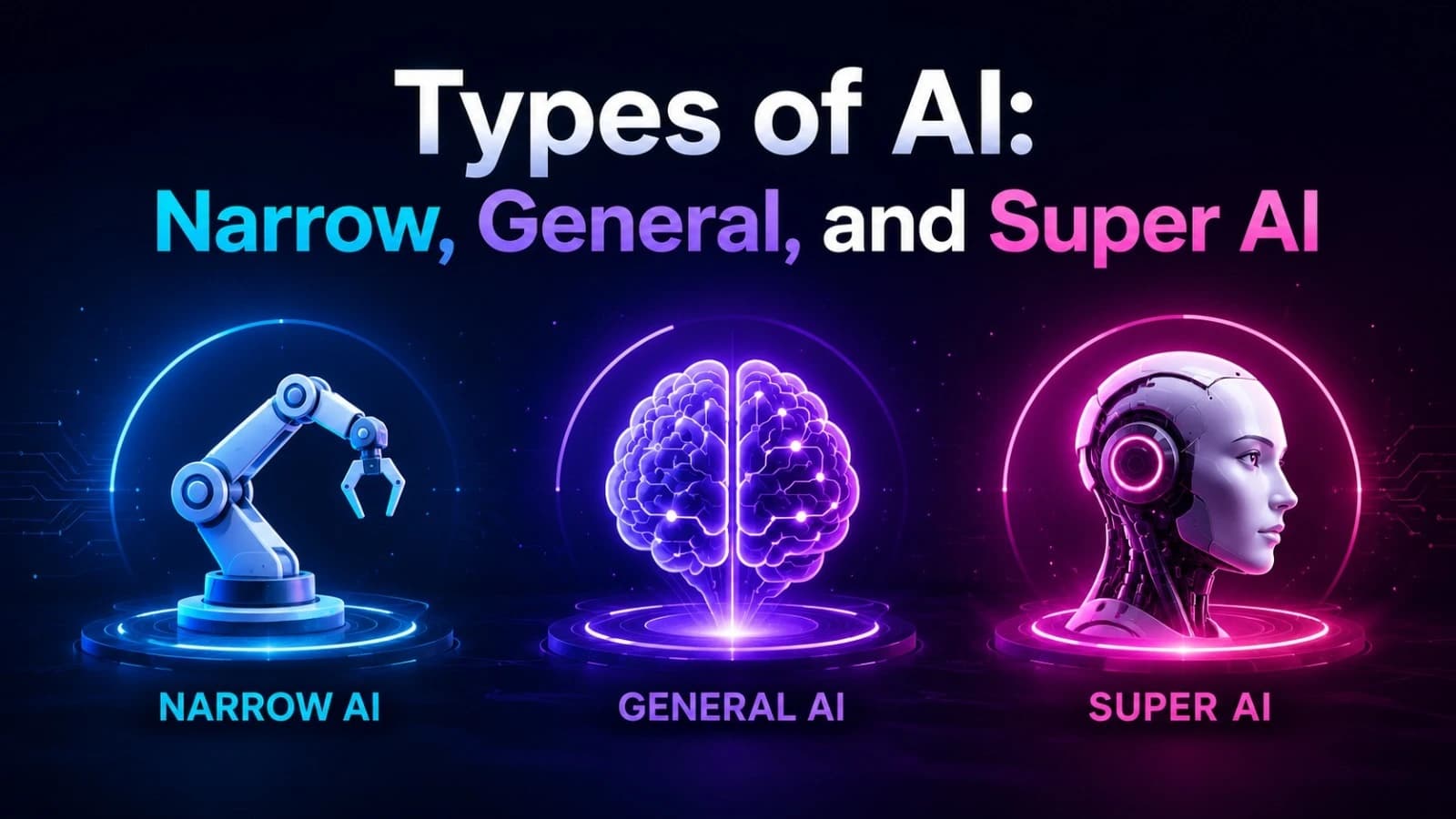
Artificial Intelligence has become one of the hottest issues of our times, finding its way into such products as smartphones and self-driving vehicles. Yet very few know that Artificial Intelligence does not constitute just one unified type of technology but rather falls into different categories of ability, starting from single-purpose machines up to future hypothetical superintelligences capable of outdoing humans. To grasp the idea of the spectrum of Artificial Intelligence is very important in order to understand both its current situation and possible future development. In this article, the three major forms of Artificial Intelligence Narrow AI, General AI, and Super AI, will be discussed and explained.
What Determines the Type of AI?
It is necessary to discuss first what sets different forms of AI apart before moving on to discuss the types themselves. It is wrong to assume that AI types depend on how complex the algorithms are or how well the output appears. The definition of different types of artificial intelligence depends on the scope of their intelligence, or, in other words, how many different tasks they are able to accomplish and how independent they are in their operations. An algorithm that recognizes faces in pictures works in an entirely different way than an algorithm that would be capable of understanding language, solving math problems, and making emotional assessments at the same time.
A Brief Look at How This Classification Developed
Classification of AI technology into three types, narrow, general, and super, arose from the realization by the AI researchers that the vast majority of technologies they were developing were highly specialized, even though they seemed smart. The first attempts of AI development in the middle of the 20th century were mainly theoretical and centered on one huge goal,creation of the machines capable of reasoning similar to that of human beings. But as computer technologies evolved throughout the second half of the 20th century and the beginning of the 21st century, the developers understood that it is much easier to develop systems for solving specific tasks than to make a machine able to reason just like a person.
1. Narrow AI (Weak AI)
It pertains to AI systems that have been created specifically and programmed only to complete one unique task perfectly. Despite looking very intelligent on account of how effectively they carry out tasks, these systems are limited in terms of intelligence only to the specific tasks that they have been designed for. A voice assistant capable of setting reminders and answering basic queries is not able to drive a car or make a medical diagnosis.
This is the only kind of AI that is present in reality at the moment. Any AI that we use now is included in this category regardless of its level of advancement.
Key traits of Narrow AI include:
Does one thing exceptionally well.
Is unable to apply the learned information elsewhere.
Requires huge amounts of training data.
Drives almost all AI products on the market.
Popular examples of Narrow AI include:
Virtual assistants such as Siri and Alexa, that are capable of interpreting voice instructions and responding in a predefined range of actions.
Recommendation systems These algorithms, used by Netflix and YouTube, among others, which monitor user actions and make recommendations based on this information but have no other use besides this.
Image recognition software , Applications vary from medical imaging to social media image recognition, where the algorithm is used to recognize patterns within an image without comprehending anything else beyond that image.
Chatbots and language models, which, although they have very good conversation skills, are regarded as Narrow AI since they work within their training limits instead of having an independent understanding.
The integration of narrow AI technology into everyday applications has been possible because of its reliability, efficiency, and specialization. Companies are attracted to it because when an application is developed for a particular task, it is possible to make it do the job faster and more accurately than any other general-purpose application. That is why although there is plenty of talk about more sophisticated AI technologies, narrow AI is still at the core of virtually all AI-based products currently in use.
2. General AI (Strong AI)
General AI, also known as Strong AI or AGI, is created with the ability to carry out various intelligent activities like humans do. This is a far more advanced concept than Narrow AI. The most important difference between General AI and Narrow AI is that while Narrow AI is designed to perform a particular task only, General AI will have the capacity to comprehend, learn, and use knowledge in a variety of applications. General AI will have the capacity to think about something that it has never encountered before and can apply knowledge from one area to another.
Key traits General AI would possess include:
Ability to think and reason abstractly.
Ability to acquire skills independently without requiring retraining.
Flexibility to use the knowledge in totally unrelated areas.
Ability to produce an essay, solve a physics problem and have a good discussion on ethics, all in one system.
One needs to take into account the fact that the General Artificial Intelligence does not exist at the moment. Although there have been many achievements in terms of machine learning and natural language processing, no current system can reason like a human on different topics at once. The confusion about what is considered the General Artificial Intelligence comes from the perception of its very advanced Narrow counterpart.
People all over the world are trying to achieve this end, and it is regarded by many as one of the major achievements that have ever taken place in computer science. However, developing a true General Artificial Intelligence system would be possible only after making some breakthrough discoveries regarding human mind and consciousness.
3. Super AI (Artificial Superintelligence)
The term “Super AI,” also known as “Artificial Superintelligence,” is used to denote an advanced form of AI that could surpass human intelligence on all counts, be it creativity, problem solving, emotional comprehension, scientific deduction, or decision making,domains where man has always been ahead of machines.
Theoretical Super AI could be something that surpasses human intelligence in all areas at the same time. This system could potentially solve any problem that has ever puzzled mankind, create new theories in science, and make choices that no man is capable of making.
This notion is purely theoretical and is highly debatable amongst scientists, philosophers, and tech leaders. While some people believe that Super AI will become an inevitable result of further development, others express deep concerns about the danger this phenomenon might bring to humanity should it appear uncontrolled and incompatible with humans’ values and security needs. Since there is no Super AI now and even whether this kind of artificial intelligence will actually emerge is questionable, all talks about it revolve around preparation and safety issues.
Narrow vs. General vs. Super AI: A Quick Comparison
Narrow AI: Task,oriented, is available today and is widely applied in real-life applications like voice assistants and recommendation systems.
General AI: Would be able to do reasoning like a human being in several domains, but is still under development and there is no example yet.
Super AI: Would be more intelligent than humans and would exceed their capabilities altogether, but exists only theoretically.
Why This Classification Matters
There is no doubt that the practical application of understanding the difference between the three types of artificial intelligence is valuable. First of all, knowing the distinction will help ordinary users understand that, whatever amazing the AI technologies they use are, there is always a limitation on the scope of their operations, meaning that it does not operate based on its own thoughts. In addition, from the business and investment perspective, it will be important to have a clear understanding of the potential of the technology. Lastly, from the legislative perspective, the classification will be essential when discussing the safety and ethical issues associated with the further development of artificial intelligence, especially considering the increase in attention to General and Super AI.
Conclusion
AI operates on a very wide spectrum, starting from everyday used Narrow AI, which is more specialized in its application, all the way to the General AI and the Super AI that is still under the investigation of both scientists and common people. While we can see the real use of Narrow AI in our technology nowadays, the concept of General and Super AI is still something that is being explored. As the development of AI technologies proceeds, the knowledge of those three types of AI will become necessary for understanding the current situation in the field.
Share this article
Related Articles
Future of AI: Opportunities and Risks
This article explains the good and bad sides of AI's future in simple terms — what it can do for us, and what dangers we need to watch out for.
7 Examples of Artificial Intelligence Applications in Our Daily Lives
This article explains what AI is in easy words and shows 7 ways you already use it every day.

How Machine Learning Works in Real Life
Machine learning is a branch of artificial intelligence that learns from data, identifies patterns, and continuously improves its predictions without being explicitly programmed for every task.