
Types of Video Games Explained (Action, RPG, Strategy)
Every video game comes down to three core genres: Action (reflexes), RPG (progression), and Strategy (intellect), the building blocks behind all modern gaming.
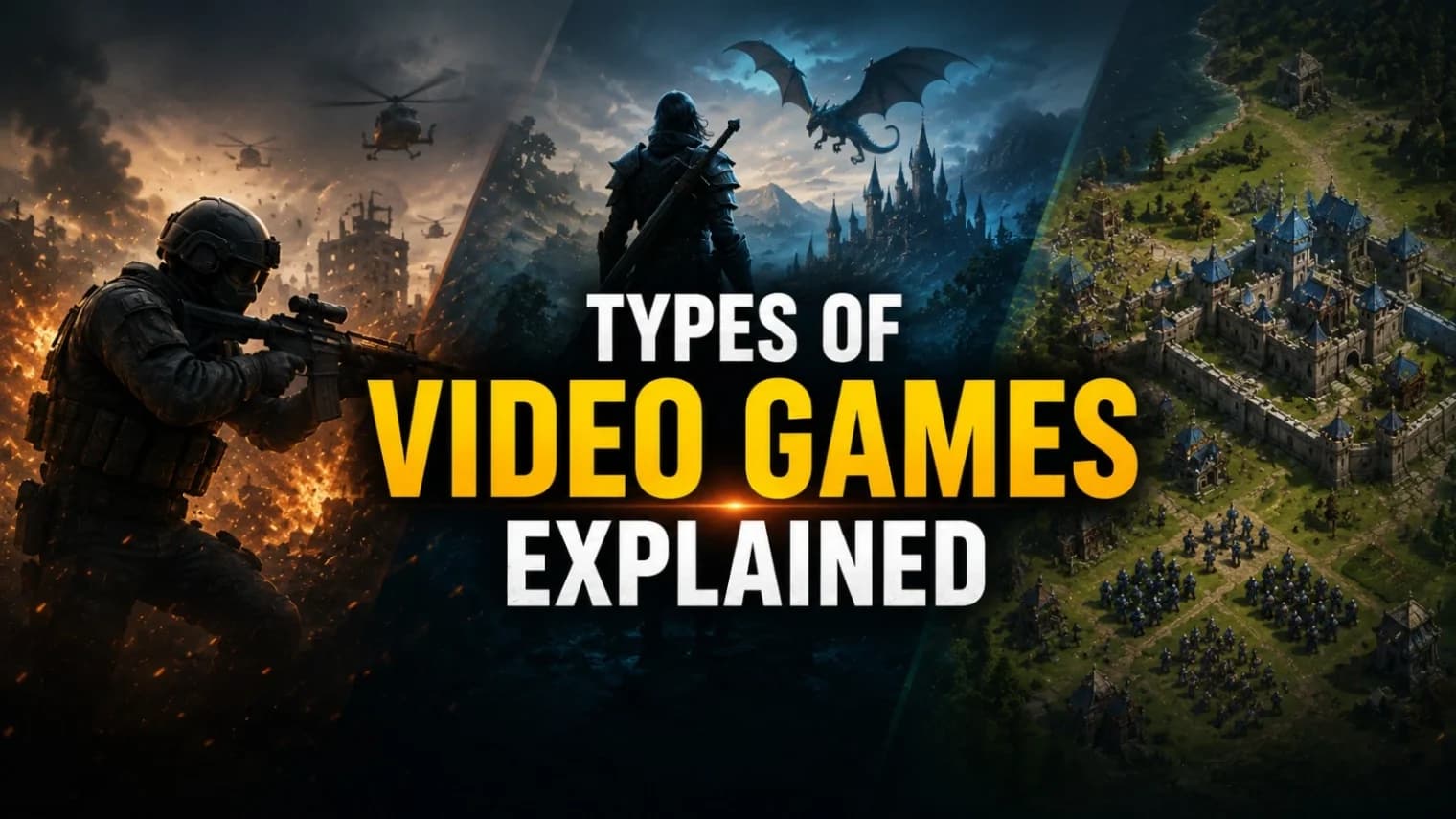
Regardless of the niche in the gaming world you happen to be in, there is no way you are not going to come across language and terminology that sounds entirely alien to you if you have not immersed yourself in this area before. However, when all of the confusing terms are disregarded, it becomes evident that all games created in the history of gaming can be categorized as belonging to one of three main genres: action, role-playing games, and strategy games. This article explains all three genres and their types in simple terms and provides examples of games.
What Makes a Game Genre?
Before we proceed with our investigation, it is important to understand that game genres are not classified by their graphics, location, or storyline. Game genre determines what kind of actions players will perform in a game. Therefore, one can learn about what actions he or she will need to take when playing the game by looking at its genre: avoid being shot, level up the hero, plan troops' moves on the map, etc. In this regard, let us consider the three fundamental genres of games.
A Brief Look at Where These Genres Came From
Genres of video games did not emerge spontaneously but rather developed along with the development of the technology capable of supporting them. The initial arcade machines of the 1970s and 1980s were simply not able to have anything but basic and fast reaction mechanisms, which explains why the action genre is among the first ones. The emergence of stronger home computers in the 1980s and 1990s allowed developers to create the world, inventory, and branching dialogues, and resulted in the creation of the RPG genre. Strategy games developed in a similar way, evolving from basic counting tasks to complicated empire-building challenges. It is clear that this evolution explains the uniqueness of these genres.
1. Action Games
Games of action rely heavily on speed, accuracy, and reflexes. You don't have much time to reflect, and success depends on how fast you can move your hands according to the on-screen events. When your palms get sweaty while playing a game, most likely you are playing an action game. These games feature rapid action with little time for rest, depend heavily on reaction and timing skills, and are skill-oriented as opposed to statistic-oriented in their development.
Popular sub-genres include platformers, where jumping, running, and avoiding obstacles through different levels are the themes of the game — Super Mario Bros. and Rayman are a few examples. Shooters (FPS/TPS) are games that revolve around shooting and fighting through first-person or third-person perspective gameplay, such as Call of Duty and Apex Legends. Fighting games revolve around knowing the best combo attacks to use and studying your opponent's play style rather than simply spamming random moves — games such as Street Fighter and Tekken have established whole communities of gamers around this type of gaming.
Action games are often the easiest for new gamers to pick up, because all the player has to do is react quickly, survive, and succeed. They are generally the most social kind of game too, because cooperative and competitive multiplayer allows friends to dive right into the action immediately. And since action games can often take place in short bursts that allow for replaying individual matches, levels, or rounds, they can comfortably fit into hectic lifestyles.
2. Role-Playing Games (RPGs)
RPGs move the emphasis from pure reflex to development and narrative. You build a character rather than just react to what happens around you — improving stats, acquiring equipment, and making decisions that influence the course of the story. One reason so many people choose RPGs is that a less skilled or less nimble player still has a chance to win. Key traits include deeper storytelling and world-building, characters leveling up by gaining experience points, skills, or equipment, and decisions that influence the direction of the story.
Popular sub-genres include Action RPGs (ARPGs), which offer an interesting combination of immediate combat and the usual level-up process. Turn-Based RPGs carry out combat in turns rather than in real time, allowing players to plan each move, similar to a video board game — popular games of this kind include Final Fantasy and Persona. MMORPGs are enormous online worlds where thousands of players quest, trade, and fight at the same time, such as World of Warcraft.
Playtimes are likely to be extended in RPGs because players not only develop their skills but also dedicate their time to creating their characters. Many RPGs include elements of world-building, which implies the presence of lore and history for various cultures within the game world. This is the reason RPG fans talk about storylines and backgrounds as much as they discuss strategies of fighting and survival.
3. Strategy Games
Strategy games flip the formula again — instead of reflexes or character growth, the emphasis is on planning, resource management, and decision-making. These games ask players to think several steps ahead, manage limited resources, and outmaneuver opponents through smart choices rather than fast fingers. Planning and forethought are stressed, along with resource and unit management, and success usually results from strategy rather than speed.
Popular sub-genres include Real-Time Strategy (RTS), where all players move at once, so speed and multitasking become significant alongside planning; Turn-Based Strategy (TBS), where players take turns making moves; and MOBA (Multiplayer Online Battle Arena), where teams of players, as in League of Legends, work together to operate one strong hero that will destroy the base of the opponents.
Strategy games appeal to people who are more problem-solving oriented than reactive. Since success relies on good decision-making and not speed, the learning curve for the strategy genre is higher compared to the other two game types — one wrong economic decision made at the start of the game can be the cause of defeat further down the line. That is another reason behind the fierce competition strategy games feature.
Action vs. RPG vs. Strategy: A Quick Comparison
Action games require reflexes and coordination, move at a fast pace, and are exemplified by Call of Duty. RPGs require planning and patience, move at a variable pace, and are exemplified by Final Fantasy. Strategy games require tactical thinking, move at a slow-to-moderate pace, and are exemplified by Civilization.
How to Choose the Right Genre for You
Whether you're a newbie or would like to explore other games, you can start by asking yourself some basic questions. Do you enjoy quick wins and instant feedback? Every time you avoid an attack or get a shot off in an action game, you get rewarded right away. Do you enjoy long-term investment and stories? RPGs encourage patience, since you can see your character and sometimes even the entire world develop over many hours. Do you enjoy solving problems more than reacting to them? Strategy games encourage you to think carefully so you can win using your brain, not speed.
Another thing to note is that these genres don't have to be separate from each other. Many modern hits actually combine various genres to create something unique — a survival crafting game may feature action combat alongside strategic base building, and a tactics RPG can combine turn-based battles with character development. Knowing the basics of Action, RPG, and Strategy helps in understanding how hybrid games work.
Why This Matters
This knowledge is not just for the sake of knowing — it is quite practical. New players may find a genre that suits them by considering their personalities, whether they are fast, strategic, or have good concentration skills. Parents can get an idea of what kind of experience is provided by a game before purchasing it for their children. Aspiring game developers can figure out which mechanics and patterns fit into which genre, which is essential information before creating something more complicated, such as hybrid genres.
Conclusion
Action, RPG, and Strategy make up the foundation of modern-day games, and all other genres, ranging from survival to battle royale, are based on some combination of these three genres. Whether it's the rush of reacting quickly to events in a game, investing countless hours into creating your perfect hero, or outplaying your enemy by out-thinking him, you will find a suitable genre for each type of player. What type of player are you? Figure out which sort of challenge motivates you — whether it's quick reflexes, time-consuming progression, or strategizing, and you'll be halfway there to choosing your next game.
Frequently Asked Questions
Which genre is best for beginners?
Action-based games require little initial learning since their control schemes and objectives are simple; reacting, moving, and winning are the basics of any action game.
Can a game belong to more than one genre?
Yes, many titles today have become hybrids. For example, the Action RPG genre involves a combination of real-time action and character progression.
Which genre requires the most time commitment?
Role-playing games, MMORPGs specifically, tend to require the most time due to their slow, gradual development.
Are strategy games only for experienced players?
Not necessarily. Although strategy games tend to be difficult to learn, many provide lower difficulty levels and tutorials to help beginners learn resource management and planning.
Share this article
Related Articles
Esports: A Complete Guide to Competitive Gaming
Esports is competitive video gaming where players and teams battle for money, fame, and recognition, much like traditional sports.
Best Free-to-Play PC Games in 2026
A simple guide to the best free PC games in 2026.

What Is Cloud Gaming and How Does It Work?
Cloud gaming lets you play games streamed from powerful remote servers, so you don't need expensive gaming hardware.